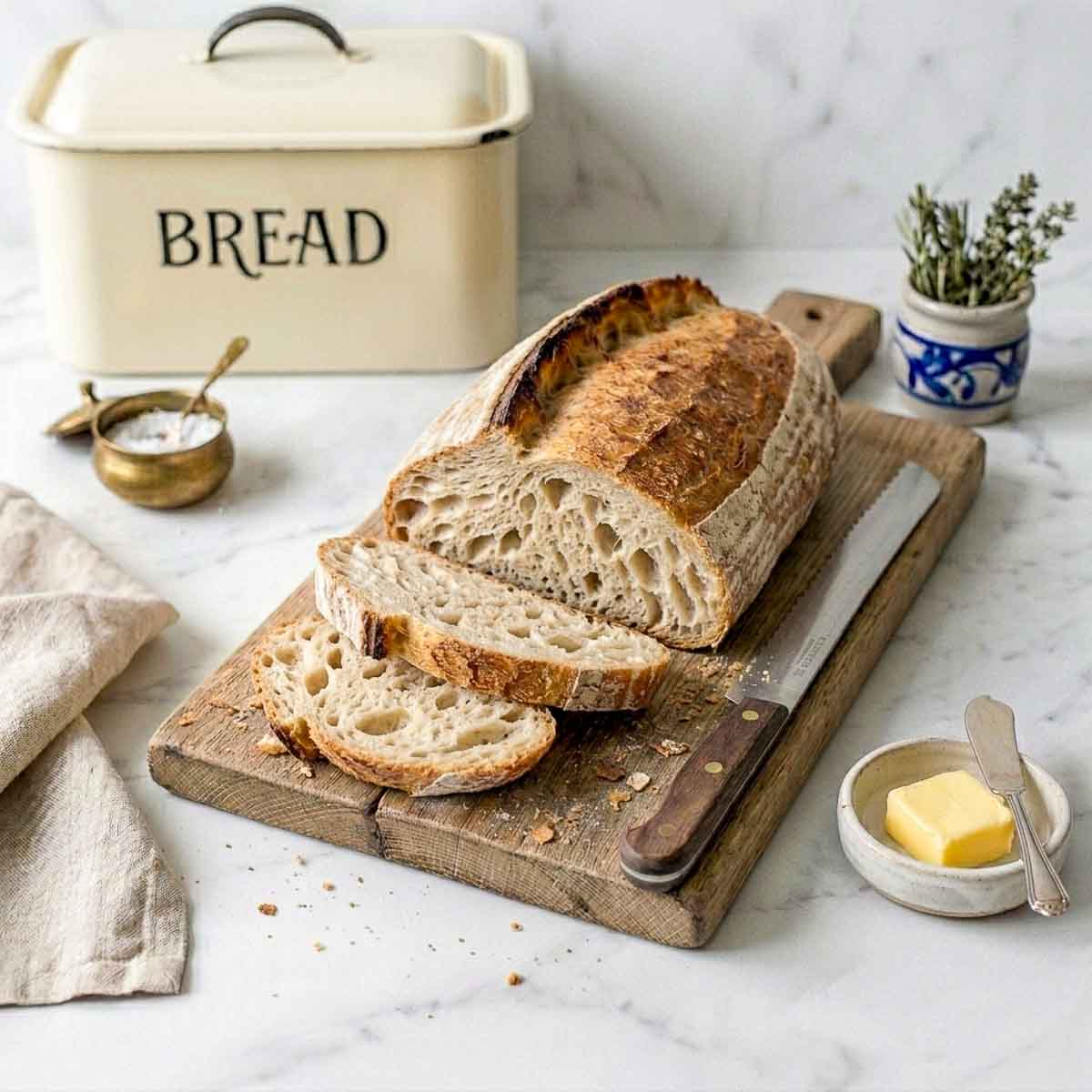
Servings: 12 slices or 1 loaf
Ingredients
- 150 g active sourdough starter at or near peak
- 350 g lukewarm water about 90 to 95°F
- 500 g bread flour
- 10 g fine sea salt
Instructions
- Stir the starter into the lukewarm water in a large bowl until the water turns cloudy.
- Add the bread flour and mix by hand or with a dough whisk until no dry flour remains. Cover and rest for 30 minutes.
- Scatter the salt over the dough. With wet hands, pinch and fold until the salt disappears and the dough feels cohesive.
- Cover and rest for 30 minutes, then do the first set of stretch and folds: lift one side up and over the center, rotate the bowl, and repeat four times.
- Repeat the stretch and folds three more times at 30-minute intervals, four sets total.
- Cover and bulk ferment somewhere warm at 78 to 82°F for 3 to 3.5 hours, until the dough has risen 50 to 75%, looks domed and airy, and shows bubbles along the sides of the bowl. Do not wait for it to double.
- Turn the dough onto a lightly floured surface, fold it into a loose round, and rest uncovered 20 minutes.
- Flatten into a rough rectangle, fold the long sides to the middle, and roll up from the short end into a taut log. Place seam side up in a floured oval banneton.
- Cover and proof at room temperature 60 to 90 minutes, until puffy and a floured finger leaves a dent that fills back in slowly.
- About 45 minutes before baking, put the covered Dutch oven in the oven and preheat to 450°F.
- Turn the loaf onto parchment and score one long slash down the length, about half an inch deep and slightly off center.
- Lower the parchment into the hot Dutch oven, cover, and bake for 20 minutes.
- Remove the lid, reduce to 425°F, and bake for 20 to 25 minutes more, until deep golden brown. Turn off the oven, crack the door, and leave the loaf inside for 15 minutes.
- Cool on a wire rack for at least 1 hour before slicing.
Notes
- Temperature drives the timeline. At 70°F, the bulk ferment runs five to six hours instead of three.
- Watch the 50 to 75% rise, not the clock.
- No warm spot? Put the covered bowl in a turned-off oven or microwave with a cup of just-boiled water beside it.
- Mark the dough's starting height on the outside of a clear glass bowl before bulk begins. It is the easiest way to judge the rise.
- Cutting before the loaf has cooled for a full hour leaves the crumb gummy. The interior is still setting.
- To convert to an overnight loaf, refrigerate the shaped bâtard in its banneton for 8 to 14 hours and bake straight from cold, adding about 5 minutes to the covered stage.
- Store cut side down on a board or in a paper bag for two days. Freeze sliced for up to three months and toast from frozen.
Nutrition
Calories: 162kcal | Carbohydrates: 33g | Protein: 5g | Fat: 1g | Saturated Fat: 0.1g | Polyunsaturated Fat: 0.3g | Monounsaturated Fat: 0.1g | Sodium: 325mg | Potassium: 42mg | Fiber: 1g | Sugar: 0.1g | Vitamin A: 1IU | Calcium: 7mg | Iron: 0.4mg
Tried this recipe? Share it Today!Mention @wholesomefamilymeals or tag #wholesomefamilymeals!