
Same-Day Sourdough Bread Recipe with a Full Hour-by-Hour Timeline
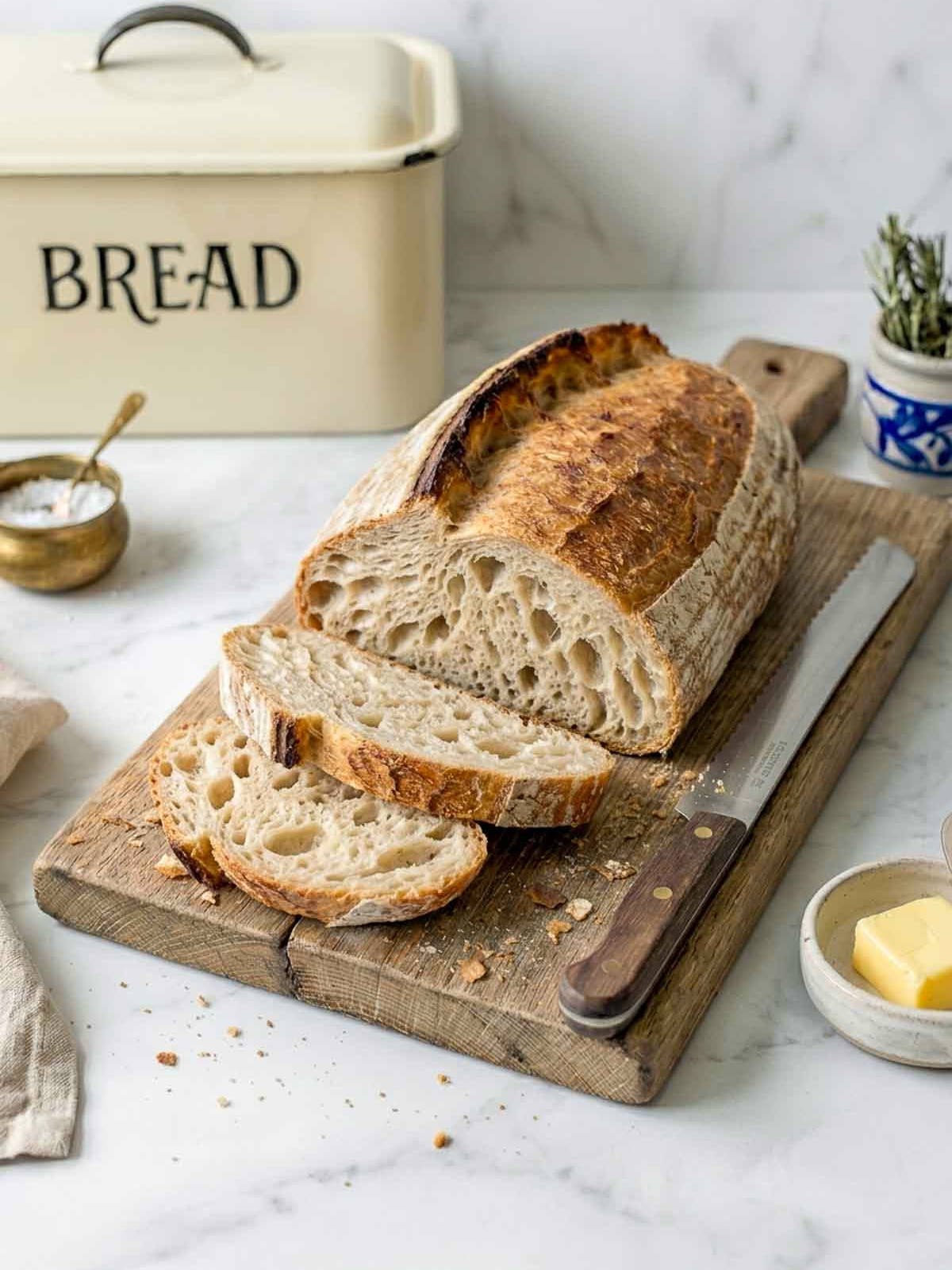
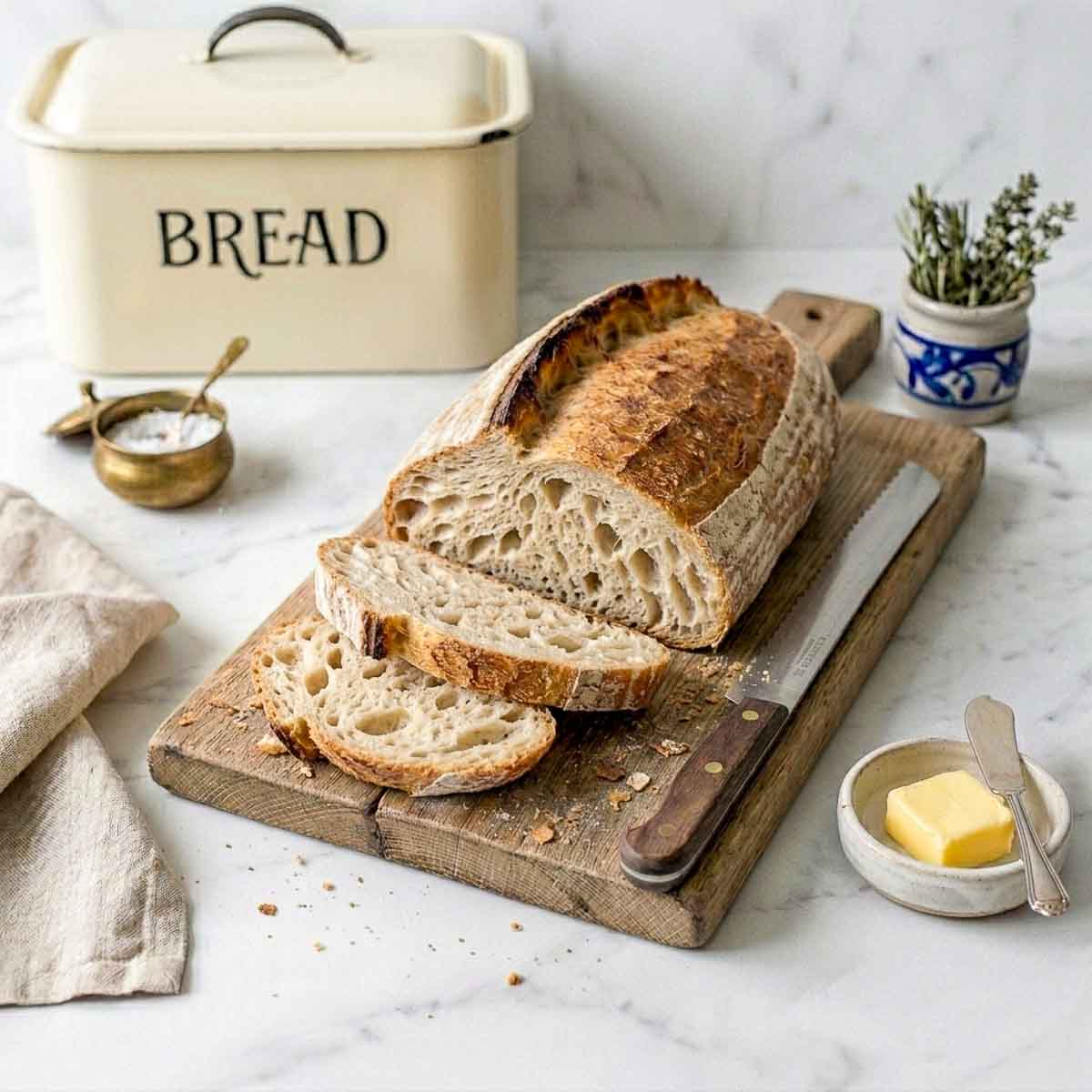
Same-day sourdough bread is a naturally leavened loaf mixed in the morning and pulled from the oven that same afternoon, with no overnight cold proof. I mix at 8:15 a.m., and the loaf is cooled and on the board by 5:30 p.m. That is about eight hours start to finish, but only thirty minutes of it is hands-on. The rest is dough sitting somewhere warm while I get on with the day. It is not the fastest sourdough bread recipe in existence, but it is the fastest one that still behaves like real sourdough.
Disclosure: This post may contain affiliate links. This means I get a small commission if you decide to make a purchase through my links at no extra cost to you.
Warmth is the only thing doing the compressing. At 78 to 82°F, sourdough bulk fermentation finishes in roughly three hours instead of the ten or twelve it takes at cool room temperature. Everything else about this quick sourdough bread stays conventional: four ingredients, 70% hydration, four sets of stretch and folds, a short bench rest, an oval bâtard proofed in a banneton, and a covered Dutch oven for the first stretch of the bake.
Jump to:

Why this loaf works on a compressed schedule
Five things make this an easy, fast sourdough bread recipe rather than a rushed one.
- The starter does the heavy lifting. 150 g of starter at peak is a lot for 500 g of flour, so fermentation begins fast instead of idling through the first hour.
- Bread flour holds the structure. The higher protein keeps the crumb open through a short, warm ferment that would flatten a weaker dough.
- 70% hydration stays manageable. Wet enough for an open crumb, dry enough to shape cleanly on a warm day.
- One bowl, no mixer. This is a no-knead sourdough bread. The stretch and folds build all the gluten it needs while the dough rests.
- Nothing goes in the refrigerator. Same-day sourdough bread is baked with no cold proofing at all, which is what keeps the whole thing within a single day.
Pin It For Later

What the baking day actually looks like
The short answer to how to bake sourdough bread the same day is to feed the starter the night before, keep the dough warm, and read the rise instead of the clock. The same-day sourdough bread schedule only holds if that first part happens. The times below assume that, plus a kitchen temperature around 78°F. A cooler room stretches the middle of the day rather than the ends.
- 8:15 a.m. Mix the starter, water, and flour, then rest.
- 8:45 a.m. Work in the salt.
- 9:15 to 10:45 a.m. Four sets of stretch and folds, thirty minutes apart.
- 10:45 a.m. to 2:00 p.m. Bulk fermentation.
- 2:00 p.m. Pre-shape, bench rest, then shape the bâtard.
- 2:30 to 3:45 p.m. Final proof in the banneton.
- 3:00 p.m. Dutch oven goes into the oven, and the oven goes on.
- 3:45 p.m. Loaf goes in.
- 4:30 p.m. Loaf comes out.
- 5:30 p.m. Slice.
Run this two or three times, and it stops feeling like a project. It becomes an easy everyday sourdough you can start on a whim.
Key ingredients
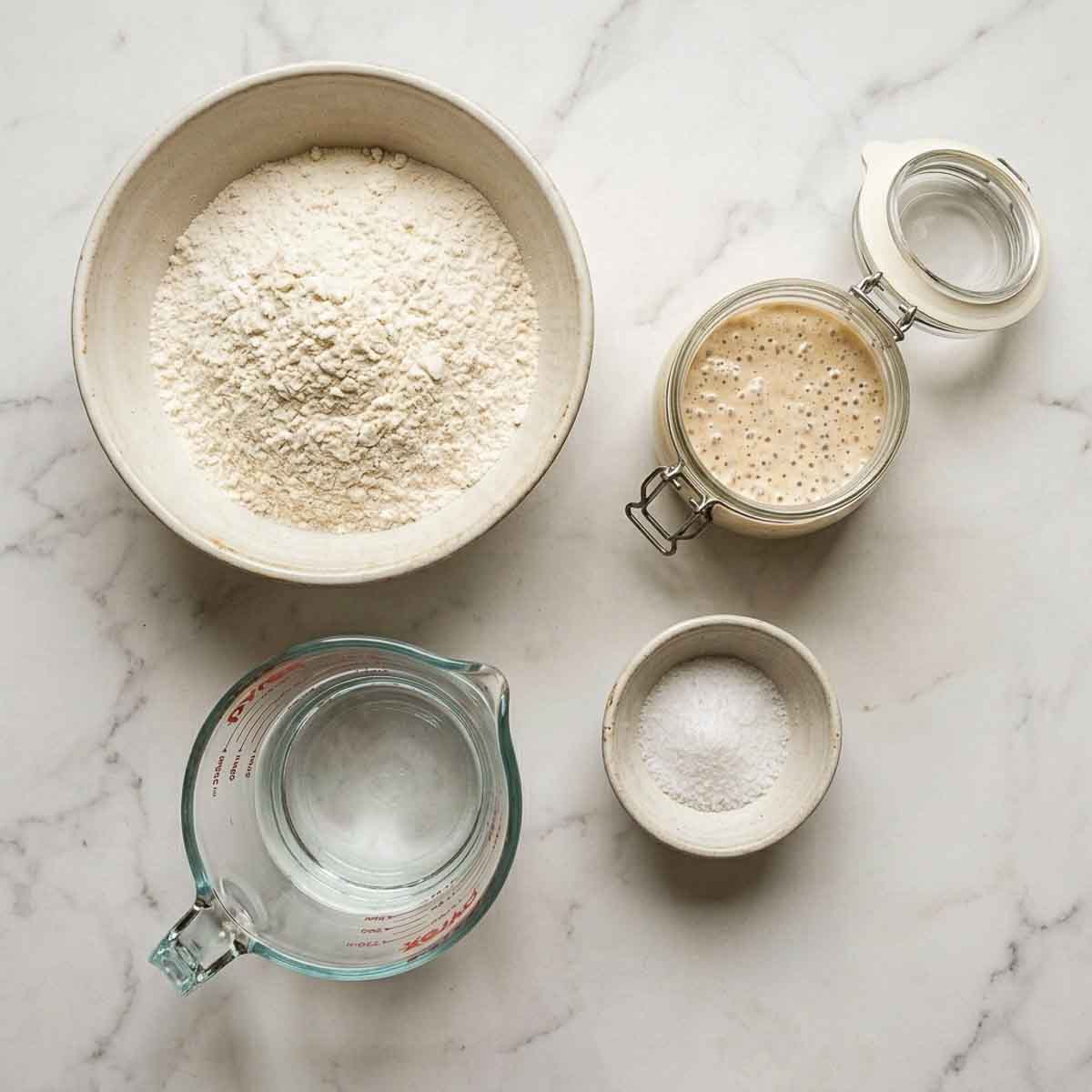
- Sourdough starter. 150 g, at or just past peak, domed and bubbly rather than flat and liquid. A sluggish starter is the most common reason a one-day sourdough bread schedule runs long. If yours is new, how to make a sourdough starter from scratch walks through the first two weeks, and feeding and maintaining a sourdough starter covers the ratios that bring an established one to a reliable peak. Peak timing matters more here than it does in an overnight bake.
- Bread flour. 500 g. Sourdough bread with bread flour holds a more open crumb through a short ferment, and all-purpose gives a softer, flatter loaf on this timeline.
- Water temperature. 350 g lukewarm, not hot. Around 90 to 95°F brings the dough up toward its target without shocking the starter.
- Fine sea salt. 10 g, held back until after the initial rest so the starter gets a clean head start.
How to make same-day sourdough bread
Making sourdough bread from scratch in a single day comes down to four ingredients and one warm corner of the kitchen.
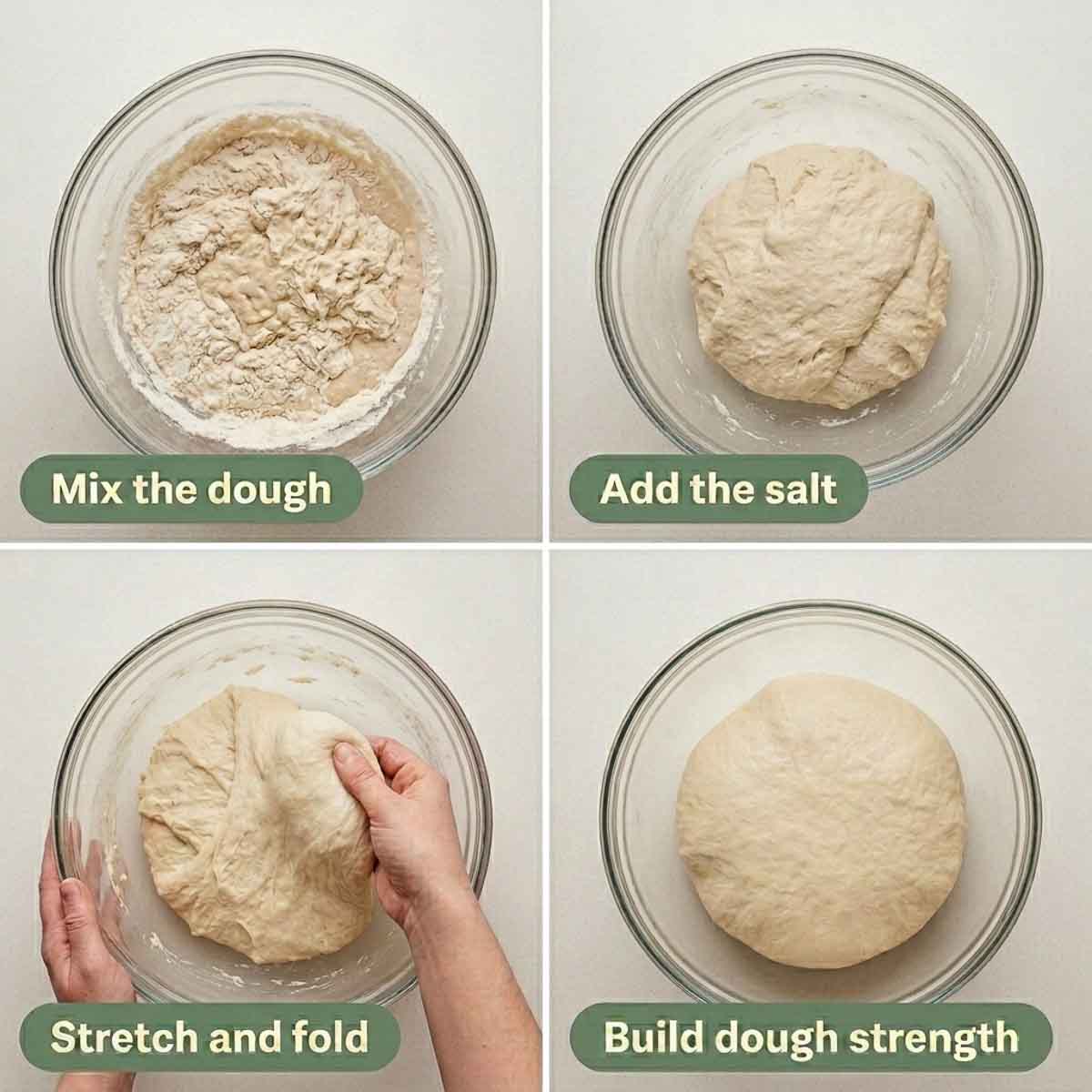
- Combine the starter and lukewarm water in a large bowl and stir until the starter breaks up and the water turns cloudy.
- Add the flour and work it in by hand or with a dough whisk until no dry patches remain, then cover and rest 30 minutes.
- Scatter the salt over the surface, wet your hands, and pinch and fold until the dough pulls together and feels cohesive.
- Cover and rest 30 minutes, then do the first set of stretch and folds, lifting one side of the dough up and over the center and rotating the bowl four times.
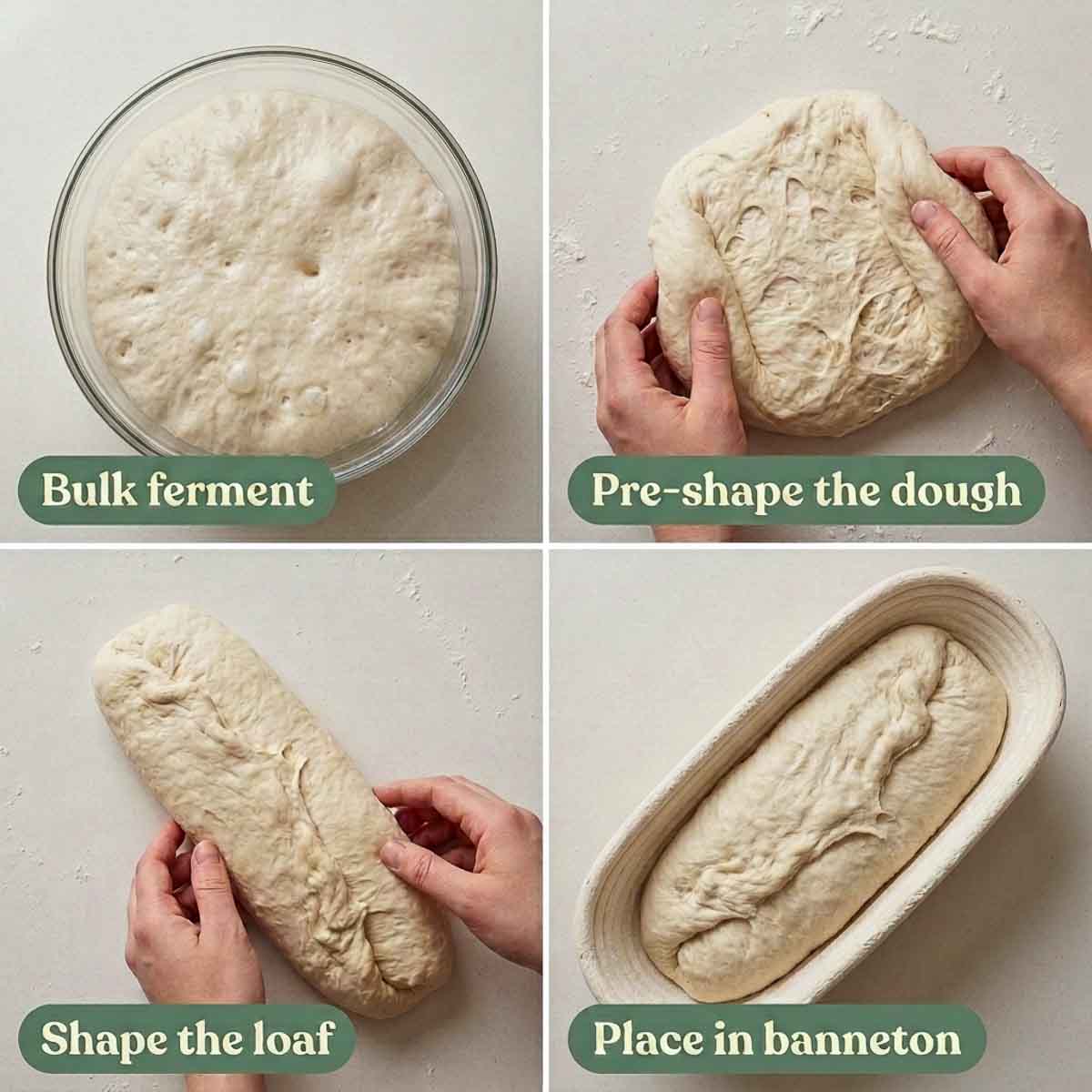
- Repeat the stretch and folds three more times at 30-minute intervals, four sets in total. The dough should smooth out and hold its shape better with each round.
- Cover the bowl and leave it somewhere warm at 78-82°F to bulk ferment for roughly 3 to 3.5 hours.
- Turn the dough onto a lightly floured counter, fold it into a loose round, and let it rest uncovered for 20 minutes.
- Shape the bâtard: flatten the dough into a rough rectangle, fold the long sides toward the middle, roll it up from the short end into a taut log, then settle it seam side up in a floured oval banneton.
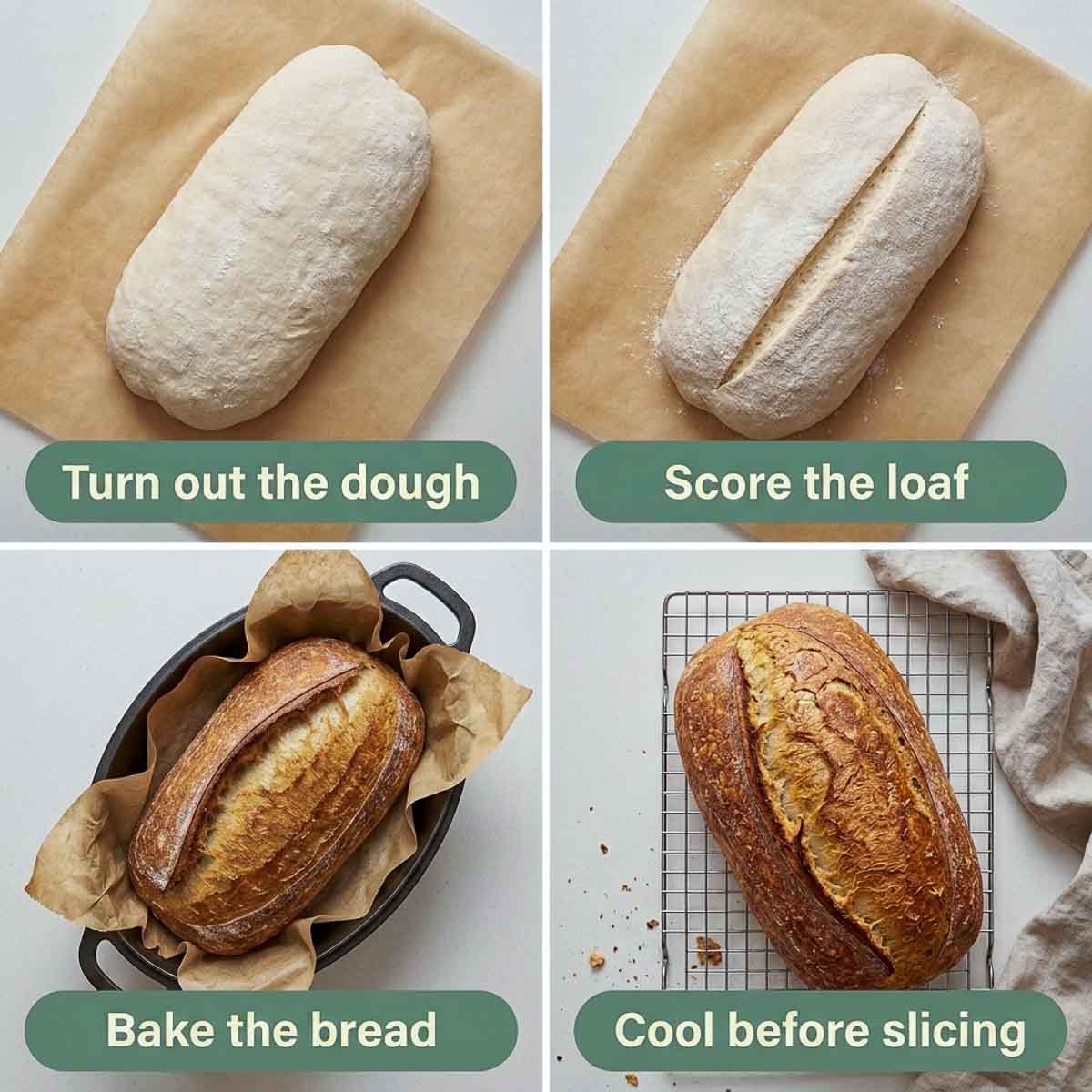
- Cover and proof at room temperature for 60 to 90 minutes, until the loaf looks puffy and a floured finger leaves a dent that fills back in slowly.
- Turn the dough out onto parchment and score one long slash down the length, about half an inch deep and slightly off center. I use a lame, but a very sharp knife does the job.
- Lower the parchment into the preheated Dutch oven, cover, and bake at 450°F for 20 minutes. Take off the lid, drop the oven to 425°F, and bake another 20 to 25 minutes, until deep golden.
- Turn off the oven, crack the door, and leave the loaf inside for 15 minutes. Move the loaf to a wire rack and leave it alone for at least an hour before cutting.
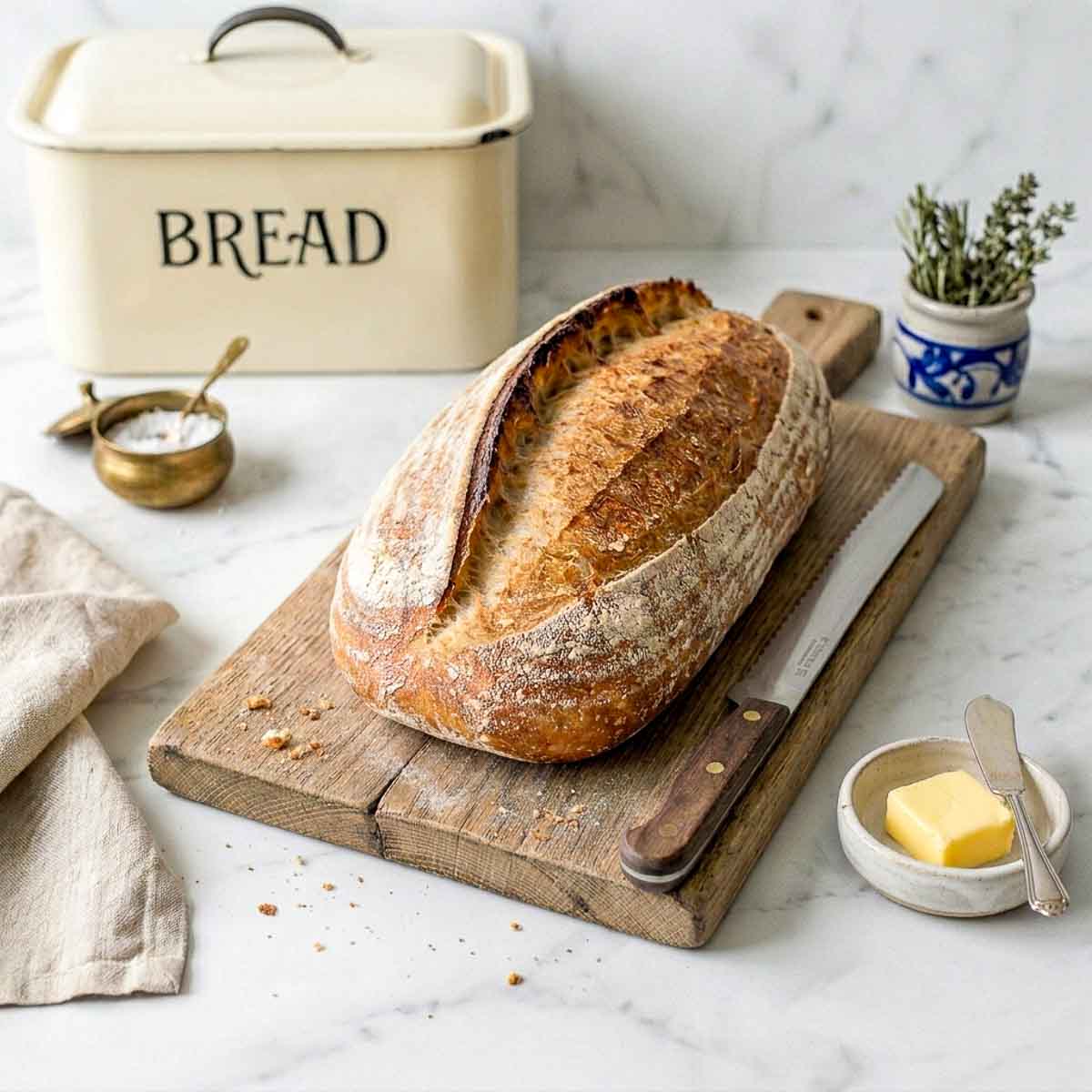
Cutting before the crumb has set leaves the middle gummy, which is the one thing that undoes a good bake on a quick sourdough bread. Give it the full hour.
Reading the dough at the end of bulk
Judging sourdough bulk fermentation by eye is the call the whole schedule rests on, so here is what I look for. No starter yet? Kefir bread gets you a same-day loaf with a similar tang using nothing but a packet of yeast and a cup of kefir.
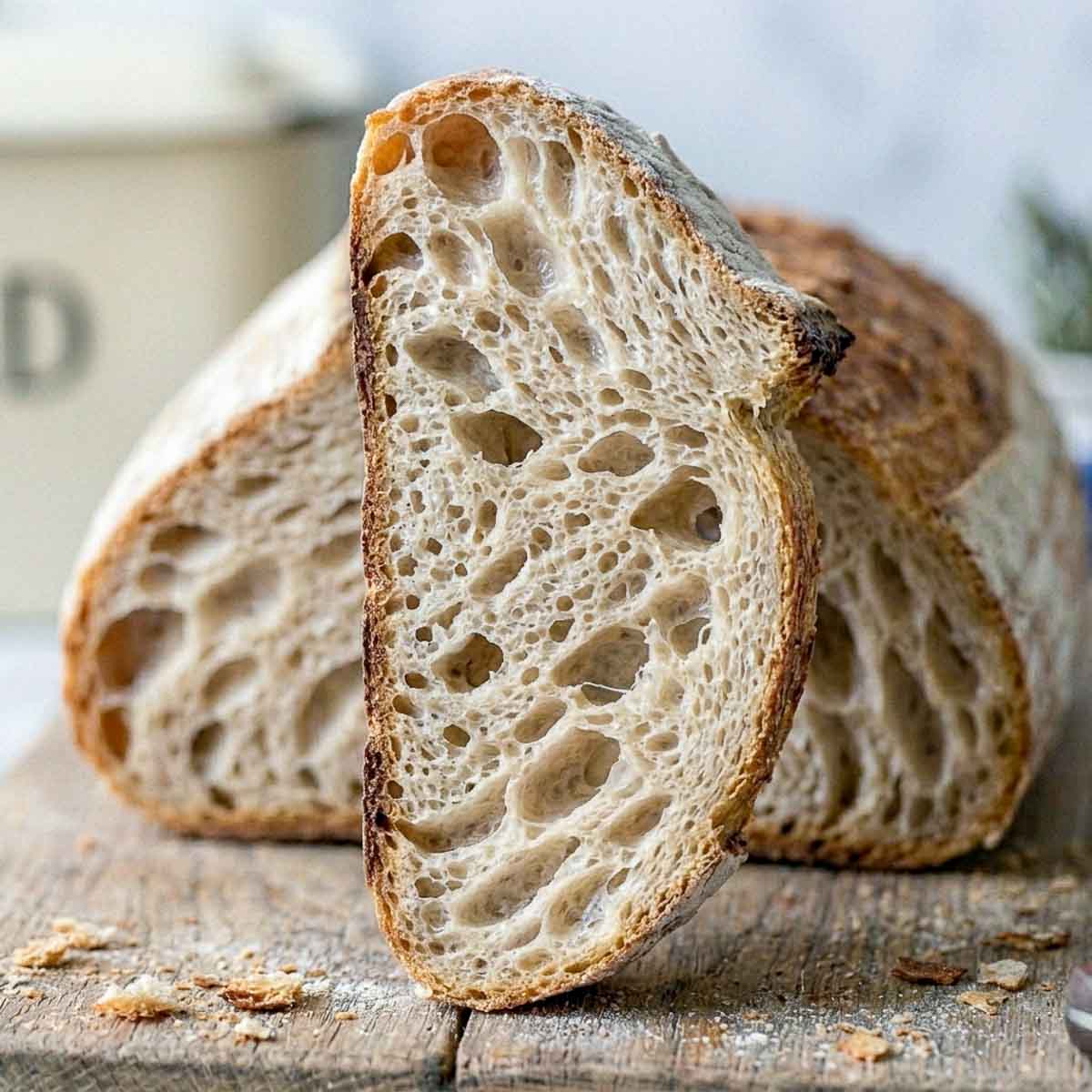
The dough should look noticeably puffed, smooth, and airy, with bubbles visible along the sides of the bowl. It should feel soft and elastic rather than dense or sticky. The biggest tell is that it has risen by about 50 to 75% and has a slight dome to the surface. Don't wait for it to double.
In a clear glass bowl, this is particularly easy to judge. Mark the dough's starting level on the outside of the bowl and watch for it to rise roughly halfway to three-quarters higher than where it started.
The biggest issue with speeding up sourdough is temperature. If the dough is too cool, the timeline stretches, and the loaf may not be ready when you expect it. A warmer proofing spot around 78 to 82°F (26 to 28°C) makes a big difference. A turned-off microwave or oven with a cup of hot water beside the bowl can create a gently warm environment without needing special equipment.
Nobody bakes foolproof sourdough bread every single time. If your loaves come out flat or tight no matter how you time them, the cause is usually one of a short list of repeat offenders. 15 common mistakes beginners make with sourdough covers the ones I see most often, and 10 common bread baking problems and how to fix them sorts symptoms by cause if you would rather work backward from the loaf you actually got.
Substitutions and variations
For this recipe, I'd stick with bread flour. The swap I'd confidently recommend is using a warmer proofing spot, especially on a cooler day. The dough ferments much more predictably when kept around 78-82°F.
- Loaf pan instead of a banneton. Shape the same bâtard, drop it into a greased 9x5 pan, skip the Dutch oven, and bake at 425°F for 40 to 45 minutes. You lose the ear and some of the crust, and you gain sandwich slices.
- Add-ins. Fold cheddar and jalapeño, or rosemary and cracked pepper, into the dough during the third set of folds so they spread evenly without tearing the gluten. 10 unique sourdough bread variations has more combinations worth trying once the basic sourdough bread recipe is dialed in.
- A sweeter loaf. If fruit and cream cheese appeal more than a savory crust, lemon blueberry sourdough bread uses the same fundamentals with a completely different finish.
- Soft sandwich version. A same-day sourdough bread recipe shaped free-form always gives you a chewy, crackly crust. For something that holds up in a lunchbox instead, sourdough sandwich bread is the softer, squarer counterpart.
- Use up the discard. Feeding a starter for a same-day bake leaves discard on the counter. I turn mine into sourdough discard crackers, which bake in under half an hour, or stir it into sourdough granola for the week's breakfasts.
- A day-old loaf is exactly what you want for sourdough stuffing with mushrooms and herbs, which bakes in one Dutch oven and can be assembled a day ahead.
What to serve with it
- Homemade sourdough bread deserves better than cold butter from a stick. Compound butter is the fastest upgrade there is and keeps for a week in the refrigerator. I spread this scallion butter thickly while the crust is still faintly warm.
- For dinner, a second loaf becomes the bowl. Thick soup inside a chewy crust is the whole meal, and there is nothing left to wash afterward. Perfect for this broccoli cheddar soup.
- Day-two slices toast better than day-one slices, which is where burrata toast with roasted tomatoes earns its place. Thick slice, hard toast, cold cheese, hot tomatoes.
Same-day sourdough bread FAQs
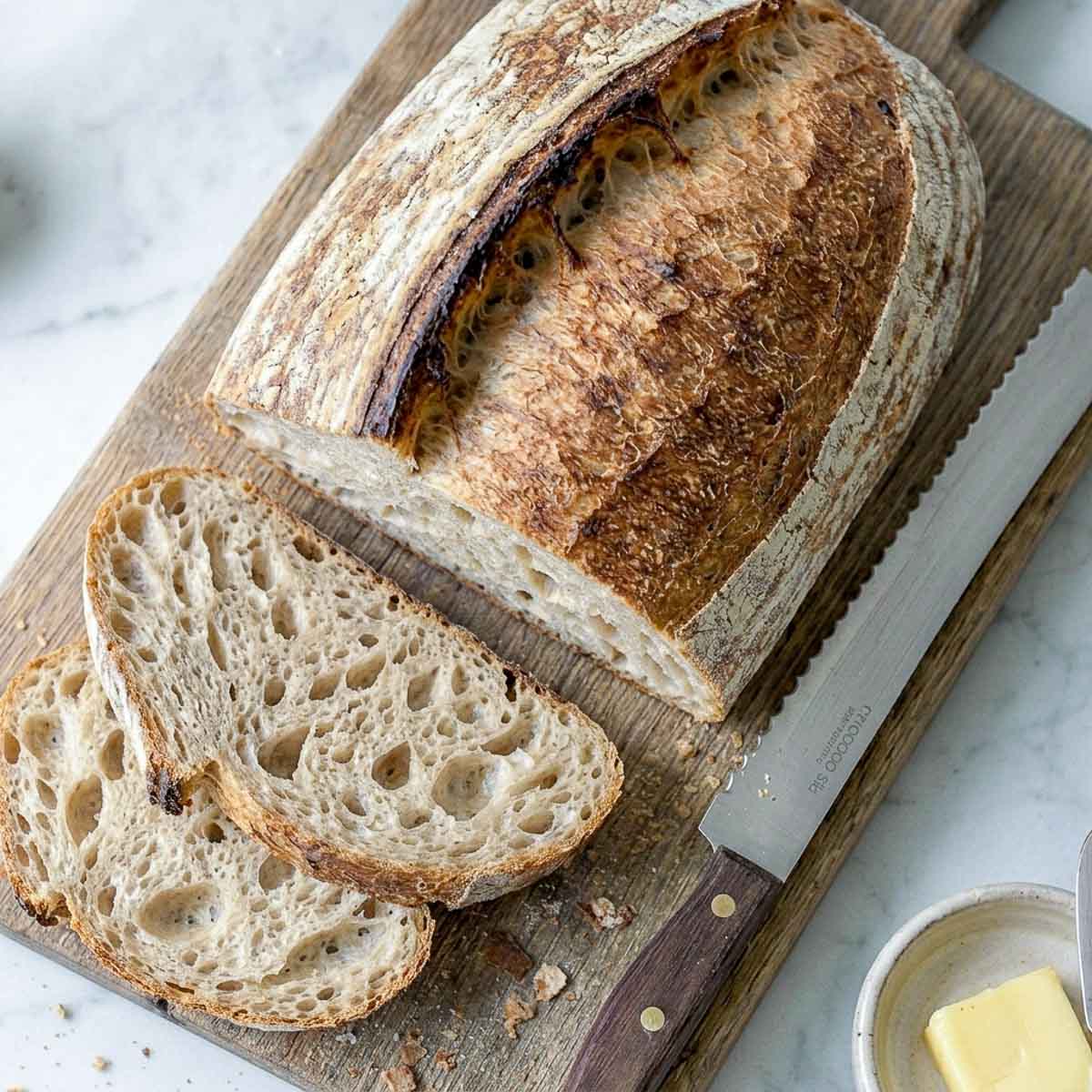
One day is enough, and one-day sourdough bread is genuinely good, but it tastes different from a two-day loaf. The overnight cold proof is what builds the sharp, sour tang people associate with long fermentation. A one-day sourdough bread recipe gives up some of that tang and gains you an afternoon. The loaf comes out milder and slightly sweeter, with the same open crumb and crust. You trade sourness for speed, not quality, which is also why this makes a good beginner sourdough bread.
Yes, and it is the best rescue available. This same-day sourdough bread recipe converts to an overnight loaf with no change to the dough itself: after shaping, cover the banneton and move it straight to the refrigerator for 8 to 14 hours, then bake it cold the next morning and add about 5 minutes to the covered stage. The score tends to open better on a cold loaf.
A fresh sourdough bread recipe like this one carries no preservatives, so treat two days as the window. Same-day sourdough bread keeps cut side down on a board or in a paper bag for that long at room temperature. Plastic softens the crust within hours. For longer storage, slice the cooled loaf, freeze it flat in a zip-top bag, and toast slices straight from frozen. A whole loaf freezes for up to three months, wrapped in parchment and then foil.
Shaping, almost always, rather than fermentation. A loosely rolled bâtard spreads sideways in the banneton instead of pushing upward in the oven. The log should feel taut and slightly resistant by the time you finish rolling it, and it should hold a clean oval rather than slumping within a minute of being shaped.

If you tried this Same-Day Sourdough Bread Recipe or any other recipe on my website, please leave a 🌟 star rating and let me know how it went in the 📝 comments below.
Ingredients
- 150 g active sourdough starter at or near peak
- 350 g lukewarm water about 90 to 95°F
- 500 g bread flour
- 10 g fine sea salt
Instructions
- Stir the starter into the lukewarm water in a large bowl until the water turns cloudy.
- Add the bread flour and mix by hand or with a dough whisk until no dry flour remains. Cover and rest for 30 minutes.
- Scatter the salt over the dough. With wet hands, pinch and fold until the salt disappears and the dough feels cohesive.
- Cover and rest for 30 minutes, then do the first set of stretch and folds: lift one side up and over the center, rotate the bowl, and repeat four times.
- Repeat the stretch and folds three more times at 30-minute intervals, four sets total.
- Cover and bulk ferment somewhere warm at 78 to 82°F for 3 to 3.5 hours, until the dough has risen 50 to 75%, looks domed and airy, and shows bubbles along the sides of the bowl. Do not wait for it to double.
- Turn the dough onto a lightly floured surface, fold it into a loose round, and rest uncovered 20 minutes.
- Flatten into a rough rectangle, fold the long sides to the middle, and roll up from the short end into a taut log. Place seam side up in a floured oval banneton.
- Cover and proof at room temperature 60 to 90 minutes, until puffy and a floured finger leaves a dent that fills back in slowly.
- About 45 minutes before baking, put the covered Dutch oven in the oven and preheat to 450°F.
- Turn the loaf onto parchment and score one long slash down the length, about half an inch deep and slightly off center.
- Lower the parchment into the hot Dutch oven, cover, and bake for 20 minutes.
- Remove the lid, reduce to 425°F, and bake for 20 to 25 minutes more, until deep golden brown. Turn off the oven, crack the door, and leave the loaf inside for 15 minutes.
- Cool on a wire rack for at least 1 hour before slicing.
Notes
- Temperature drives the timeline. At 70°F, the bulk ferment runs five to six hours instead of three.
- Watch the 50 to 75% rise, not the clock.
- No warm spot? Put the covered bowl in a turned-off oven or microwave with a cup of just-boiled water beside it.
- Mark the dough's starting height on the outside of a clear glass bowl before bulk begins. It is the easiest way to judge the rise.
- Cutting before the loaf has cooled for a full hour leaves the crumb gummy. The interior is still setting.
- To convert to an overnight loaf, refrigerate the shaped bâtard in its banneton for 8 to 14 hours and bake straight from cold, adding about 5 minutes to the covered stage.
- Store cut side down on a board or in a paper bag for two days. Freeze sliced for up to three months and toast from frozen.