
How to Feed and Maintain a Sourdough Starter: Ratios, Schedules, and Fixes
Once a sourdough starter is established, maintenance is a rhythm rather than a project. You feed it, it rises, it falls, and you feed it again. The standard feed is equal weights of starter, flour, and water, written as 1:1:1. Keep 50 grams of starter, add 50 grams of bread flour and 50 grams of filtered water, and discard the rest. On the counter at room temperature, that happens once every 24 hours, or twice if your kitchen runs warm. In the fridge, it drops to once a week.

Disclosure: This post may contain affiliate links. This means I get a small commission if you decide to make a purchase through my links at no extra cost to you.
The counter routine is for people baking several times a week. The fridge routine is for everyone else, and it is the one that keeps a starter alive through a normal family schedule. Neither is better. A starter that lives in the fridge and gets fed on Sundays bakes just as well as one fed twice a day, as long as you wake it up before you use it.
The one skill worth learning is reading peak. A starter is strongest at the moment it stops rising and just before it begins to sink, usually four to eight hours after feeding. Use it then. Most disappointing loaves are not a starter problem; they are a timing problem.
If yours is sluggish, runny, or has dark liquid on top, none of those mean it has died. All three are fixable, and each one is covered below. If your starter is not established yet, start with the 7-day sourdough starter guide instead.

Two Routines, Pick One

- Counter, for frequent bakers. Feed once every 24 hours at 1:1:1. The starter stays permanently active and is ready to use most of the day. Costs you a feed every day and a fair amount of discard.
- Fridge, for everyone else. Feed once a week. The cold slows fermentation almost to a stop, so the starter holds steady between feeds. Costs you a wake-up feed before you bake.
Most home bakers should choose the fridge and stop feeling guilty about it. A weekly feed is a sustainable habit. A twice-daily feed for a starter you use twice a month is not, and a starter you resent is a starter you eventually throw out.
A starter kept on a regular feeding schedule is exactly what a sourdough sandwich bread needs, since that loaf relies on the starter alone with no commercial yeast to fall back on. Choosing the harder routine and then abandoning it is one of the common mistakes beginners make with sourdough.
After trying both room-temperature and refrigerated maintenance, I settled on keeping my starter in the refrigerator because I usually bake only once or twice a week. It keeps the routine simple, uses much less flour, and I've found it much easier to stay consistent with weekly feeds than trying to keep up with daily maintenance. If discard is piling up faster than you can bake with it, sourdough discard crackers use a full cup at a time.
How Often To Feed A Sourdough Starter
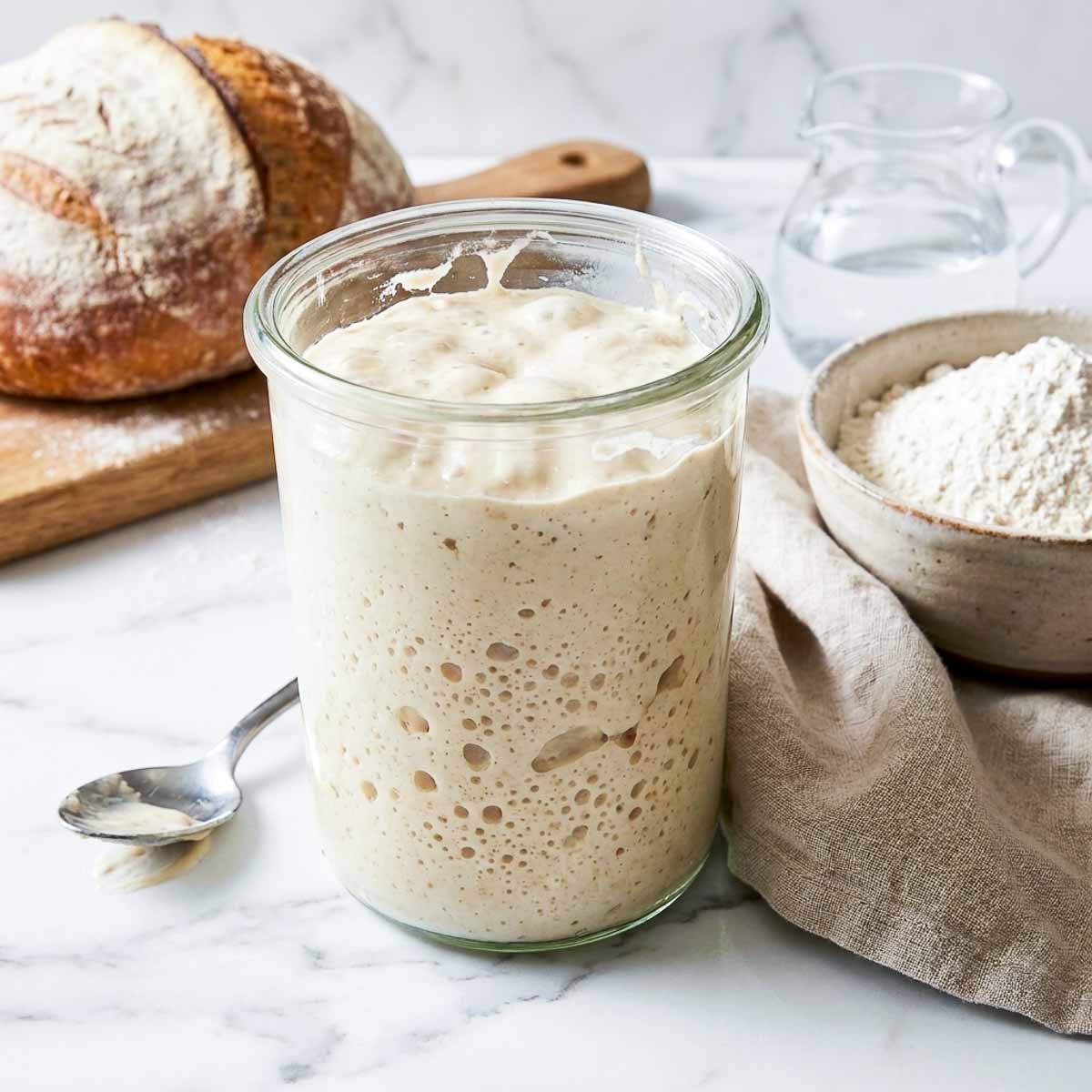
- Counter, warm kitchen above 78°F. Twice a day, about 12 hours apart. Ready to bake 4 to 6 hours after a feed.
- Counter, average kitchen 68 to 75°F. Once a day. Ready to bake 6 to 8 hours after a feed.
- A fridge starter runs on a different clock, and that routine is covered further down.
The frequency is driven by temperature, not by the calendar. A starter in a warm kitchen eats faster and needs feeding sooner. If yours peaks and collapses well before the next scheduled feed, feed it more often or move it somewhere cooler. Feeding a starter on a schedule means a jar of discard building up in the fridge, and there is only so much you can do with a quarter cup at a time. Sourdough granola takes a full cup of unfed discard and turns it into big crunchy clusters that keep for weeks.
Pin This For Later

Feeding Ratios, And How Much To Feed
The ratio is written starter:flour:water, by weight. The first number is how much starter you keep; the other two are what you feed it.
- 1:1:1, the standard. Keep 50 g starter, feed 50 g flour and 50 g water. This is the everyday counter feed and the one to use unless you have a reason not to.
- 1:2:2, for a longer gap. Keep 25 g starter, feed 50 g flour and 50 g water. More food per unit of culture, so it takes longer to peak. Useful in a warm kitchen or when you need to stretch the time between feeds.
- 1:5:5, overnight. Keep 20 g starter, feed 100 g flour and 100 g water. Feed this before bed, and it will be at peak in the morning.
- 1:1:1 small, for less discard. Keep 20 g starter, feed 20 g flour and 20 g water. Same ratio, smaller jar, less than half the flour going in the bin.
More flour relative to starter means more food and a longer time to peak. That is the whole logic. If you want your starter ready in the morning, feed it a bigger ratio at night. Weigh everything. A cup of flour varies by up to 20 percent depending on how it was scooped, and ratios built on cups drift. Timing the feed matters most when the whole bake has to fit inside a single day. Feed the night before, and you can mix this same-day sourdough bread first thing in the morning, with the starter hitting peak exactly when you need it.
How To Read Peak And Fall
This is the part that separates a starter that bakes well from one that technically works.
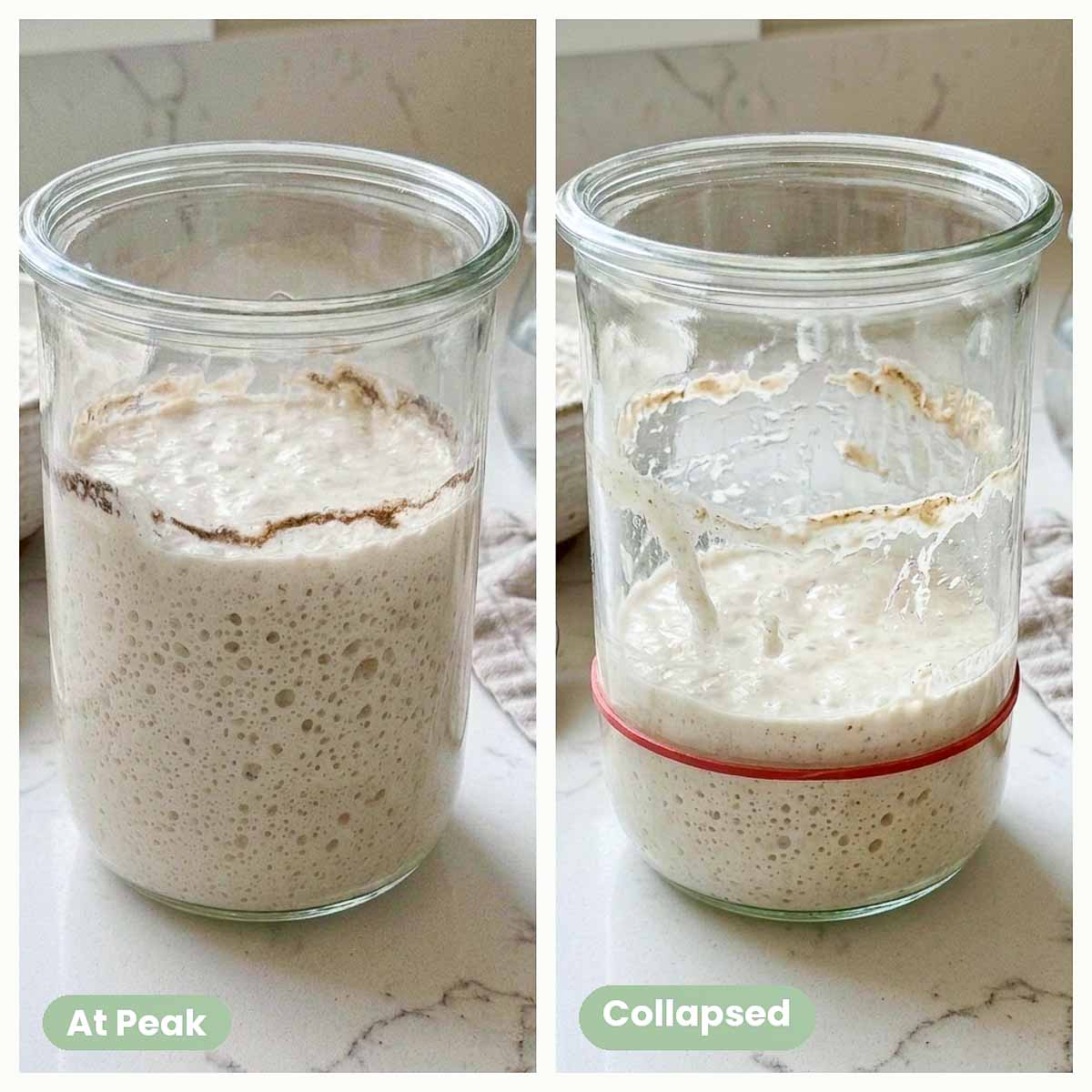
After a feed, a starter rises, holds at its highest point, then sinks back. Peak is that highest point, and it is when the culture has the most gas and the most lifting power. Use it within an hour or so either side.
Put a rubber band around the jar at the level of the starter right after feeding. When the starter reaches double that mark, and the surface goes from domed to flat, you are at peak.
After it falls, the surface sinks, a residue line is left high on the glass showing where it got to, and the texture loosens. A fallen starter is not ruined and will still leaven bread, more slowly and with a sharper flavor. But if your loaves are dense and you cannot work out why, this is the first thing to check, ahead of the other usual bread baking problems.
What finally clicked for me was realizing that my starter doesn't follow the clock. It follows my kitchen. In warmer weather it can peak much sooner than expected, while cooler days stretch the timeline. Now I look for a doubled starter with a rounded top and lots of bubbles instead of relying on a specific number of hours before mixing my dough.
Keeping A Starter In The Fridge
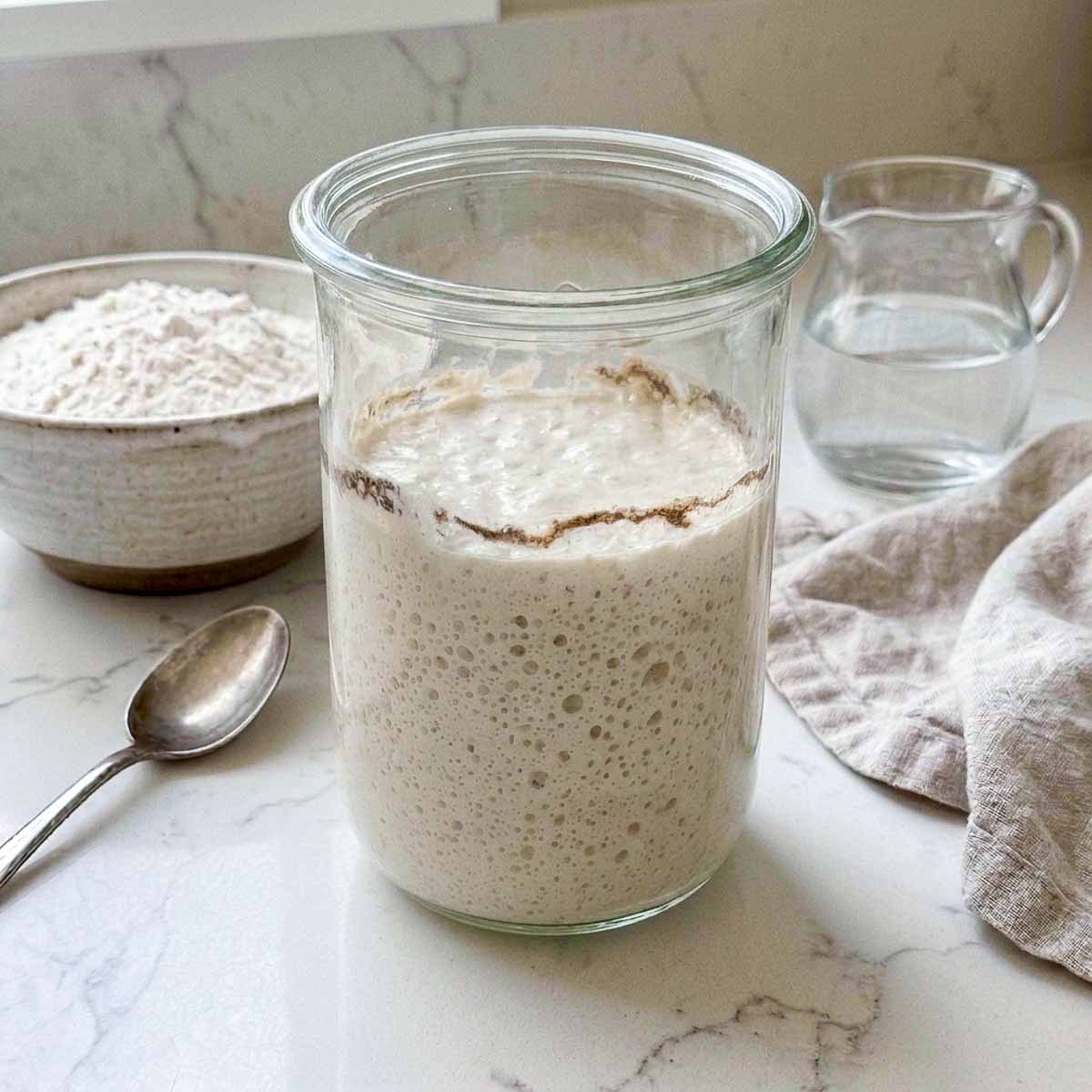
To store it. Feed the starter, let it sit at room temperature for an hour or two to get going, then seal it and refrigerate. Feeding right before it goes in gives it food to sit on.
To maintain it. Once a week, take it out, discard down to 50 grams, feed 1:1:1, leave it on the counter for two hours, and put it back. The whole thing takes five minutes.
To wake it up for baking. Take it out the day before. Discard down to 50 grams and feed 1:1:1. Leave it on the counter. After 8 to 12 hours, feed again. After the second feed it should double within 4 to 8 hours, and that is when it is ready. A starter that has been cold for a long time may need a third feed.
If you forgot it for a month. It is probably fine. There will be a layer of dark liquid on top and it will smell sharp. Pour off the liquid, scrape 20 grams from the middle of the jar into a clean jar, and start feeding twice a day. Most starters come back within three days.
Sourdough Starter Maintenance FAQs
Why isn't my sourdough starter rising? Cold is the most common cause. Below about 68°F, fermentation slows dramatically, and a starter can look dead while being perfectly healthy. Move it somewhere warmer and give it two or three feeds before judging. The second most common cause is underfeeding: a starter fed once a day in a warm kitchen may be peaking and collapsing before you ever see it. Try feeding twice, or watch it hourly for one cycle to find out when it actually peaks.
How do I strengthen a weak sourdough starter? Feed it twice a day at 1:1:1 so it never sits hungry, and keep it somewhere consistently warm. Warmth matters more here than any ingredient change. Give it three or four days of that rhythm before deciding it has not worked. If it is still sluggish after a week, try a different bag of flour.
How do I get rid of hooch in my sourdough starter? Hooch is the dark liquid that forms when a starter has used up its food. Pour it off for a milder starter or stir it back in for a tangier one, then feed straight away. Recurring hooch is a message: feed more often, or use a bigger ratio so there is more food between feeds.
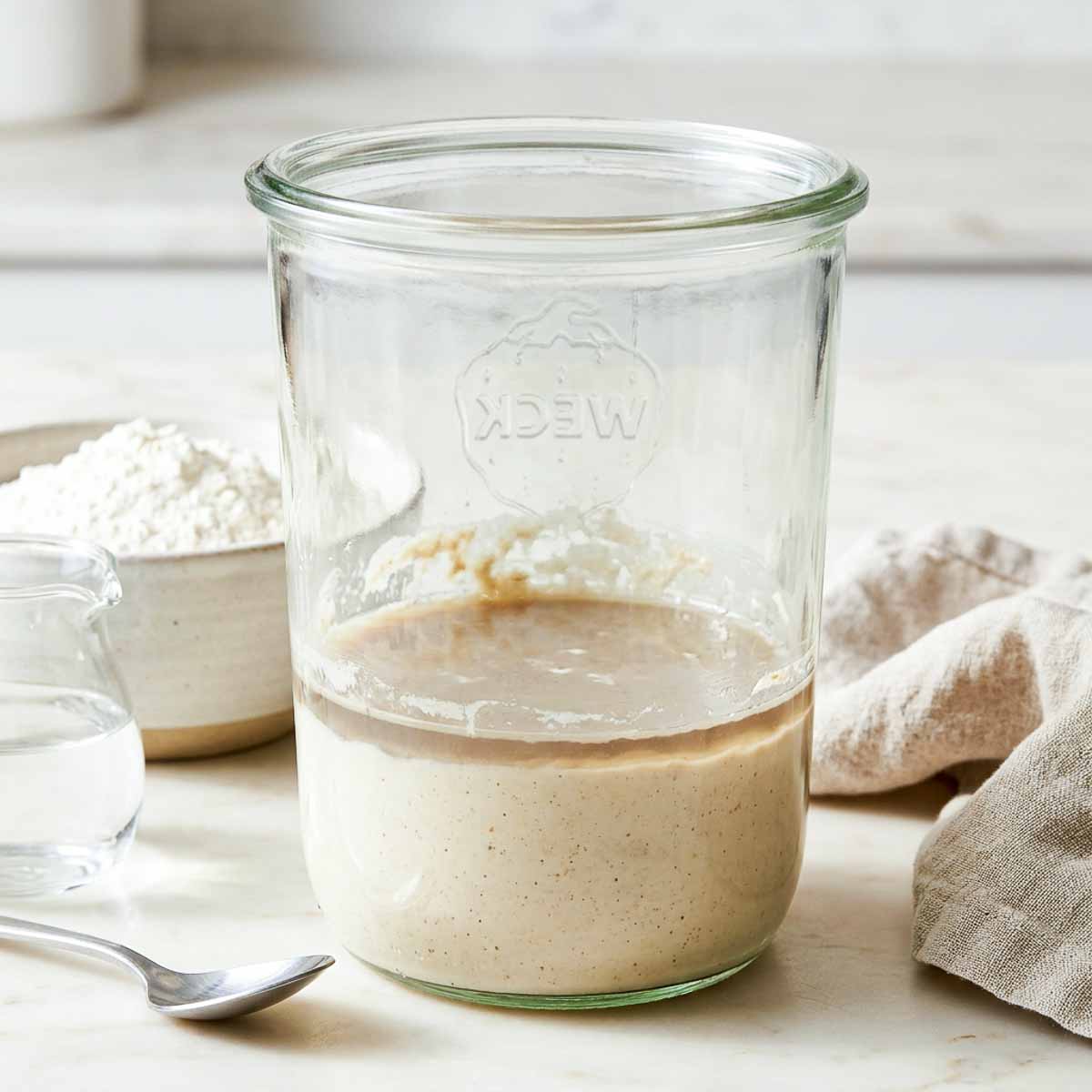
How do I fix a runny sourdough starter? A starter that has gone thin and liquidy is usually too warm and eating too fast. Move it to a cooler spot and feed on schedule. If it is still slack, hold back a little water on the next feed to bring it to a thick batter consistency and keep it there.
How long can a sourdough starter go without feeding? On the counter, a few days before it weakens noticeably. In the fridge, several weeks, and often months. A neglected starter is far more likely to need reviving than replacing. Missing a feed does not kill it, and the recovery steps above work on starters that have been ignored for a long time.
Can a sourdough starter go bad? Rarely, but yes. Fuzzy growth, black or orange spots, or a pink tinge means throw it out and start again. Dark liquid, a sharp smell, and grey discoloration are all normal and fixable. When in doubt, the test is fuzz: mold is fuzzy, hooch is not.
Do I have to discard every time I feed? While you are maintaining a starter at a steady size, yes, or the jar fills up, and the ratio collapses. You can keep a much smaller starter, 20 grams instead of 50, which cuts the discard by more than half and still bakes fine. You can also collect discard in a jar in the fridge and use it rather than bin it, in pancakes, crackers, or a loaf like this banana bread.
What is the best container for a sourdough starter? A clear, wide-mouth glass jar with a loose lid. Clear so you can read the rise and see the residue line after a fall. Wide-mouth so stirring and scraping are not a fight. Never seal it airtight, since fermentation produces gas that needs somewhere to go. The rest of the bread baking tools can wait until you are baking regularly.
I'm going away for two weeks. What do I do? Feed it, let it sit out for an hour, then refrigerate it and leave it. Two weeks is well within what a fridge starter tolerates. When you get back, run the wake-up routine above.
Keeping Your Starter Going
Once the weekly rhythm is a habit, the starter mostly takes care of itself. If you are still building yours and it is not yet doubling reliably, the seven-day starter guide covers that stage. When you are ready to bake, a beginner sourdough loaf is where the routine pays off, and from there these sourdough bread variations will keep you busy.

How often do you feed yours, and does it live on the counter or in the fridge? Tell me in the comments. I am always curious how other people fit this around a real week.
Equipment
- Wide-mouth glass jar (32 oz)
Ingredients
- 50 g active sourdough starter
- 50 g bread flour unbleached
- 50 g filtered water
Instructions
- Weigh the jar with the starter in it and discard down to 50 g, saving the discard in a separate jar in the fridge if you want to use it.
- Add 50 g bread flour and 50 g filtered water. Stir until no dry flour remains and scrape down the sides.
- Mark the level with a rubber band. Rest the lid on loosely.
- Leave in a warm spot. The starter is at peak when it has doubled and the domed surface just begins to flatten, usually 4 to 8 hours.
- Use it at peak, or feed again, or refrigerate it for the week.
Notes
- Feeding schedule: once daily on the counter, twice daily above 78°F, once weekly in the fridge.
- Ratios: 1:1:1 standard, 1:2:2 for a longer gap, 1:5:5 overnight. First number is starter, then flour, then water, all by weight.
- To wake a fridge starter for baking, feed twice at 1:1:1, 8 to 12 hours apart, starting the day before you bake.
- Keep a 20 g starter fed at 1:1:1 if you want much less discard.
- Dark liquid on top means hungry, not spoiled. Fuzzy growth or pink or orange color means start over.